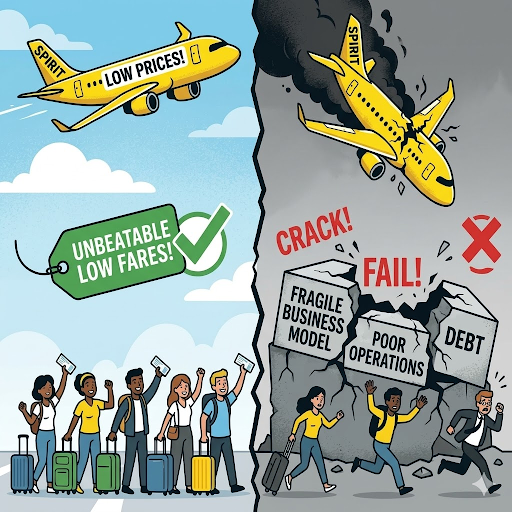
On May 2, 2026, Spirit Airlines ceased all operations. Flights were grounded. The airline’s website was locked. Approximately 17,000 employees were laid off overnight — many without advance notice, their work lives ended by a press release. For millions of Americans who had boarded Spirit flights to visit family, take first vacations, or reach jobs that required travel, the news carried a particular weight. This was the airline that had lowered the price of flying to the point where it was genuinely accessible. That it ended so completely, and so suddenly, felt like more than a corporate failure.
But the collapse of Spirit Airlines was not sudden. It was the final act of a structural tragedy years in the making. The airline accumulated roughly $5.9 billion in cumulative losses since 2020 and had not reported an annual profit since 2019. What appeared to the public as a thriving discount operation was, beneath the surface, a business in steady and accelerating deterioration.
Spirit’s story is not merely an airline story. It is a masterclass in what happens when growth outpaces resilience, when a single competitive advantage is allowed to erode without replacement, and when strategic options are exhausted one by one until none remain. Every executive — in aviation, in retail, in technology, in manufacturing — will find something instructive in what Spirit got right, and in what it never fixed.
The Mirage of a Model
Spirit Airlines did not merely compete on price. It built an entirely new architecture around price. Beginning in 2007, Spirit pioneered the ultra-low-cost carrier (ULCC) model in the United States, unbundling its fares in a manner that was, at the time, genuinely radical. Passengers paid for the seat. Everything else — checked bags, carry-ons, seat selection, a glass of water — was purchased separately. The model was built on a simple insight: a significant portion of air travelers want the lowest possible base fare, and they are willing to manage the rest themselves.
It worked. Non-ticket revenue per passenger grew from roughly $5 in 2006 to $69 by 2023 — a figure that reflected how completely the airline had retrained its customers and restructured its economics. For a period, Spirit’s unit economics were the envy of the industry. Its cost structure was leaner than anything the legacy carriers could match, and its revenue-per-seat model was cleverly engineered to extract value from passengers who thought they were paying almost nothing.
But a competitive model is only durable for as long as it cannot be replicated. Beginning in 2012, the major carriers — Delta, American, United, and Southwest — introduced their own “basic economy” fares, replicating Spirit’s unbundled pricing architecture while retaining advantages that Spirit could never match: established loyalty programs with tens of millions of enrolled members, broader and more frequent route networks, stronger balance sheets, and decades of brand trust. The legacy carriers did not merely enter Spirit’s price tier. They entered it with far superior infrastructure surrounding it.
Spirit’s competitive moat had been price. When rivals dug an equally deep moat, Spirit had no second line of defense. The business lesson is a clear one: a single-dimension competitive advantage is not a strategy — it is a vulnerability. Companies that win on price alone must simultaneously build on service quality, brand loyalty, or customer experience, or face the near-certain prospect of being outcompeted by better-resourced rivals who can afford to match them on cost while offering more of everything else.
Growth Without Resilience
Behind Spirit’s growth narrative was a financial structure of alarming fragility. By 2025, the airline posted a net loss of $2.8 billion, an EBIT margin of -23.6%, and negative operating cash flow of $930 million. Its revenue-per-available-seat-mile to cost-per-available-seat-mile gap stood at -1.4 cents — meaning the airline was losing money on every mile it flew. These are not the numbers of a company navigating a difficult quarter. They are the numbers of a business whose operating model had ceased to function.
The financial exposure was compounded by the structure of the fleet itself. Approximately 83% of Spirit’s aircraft were leased rather than owned, leaving the airline with limited financial flexibility and exposing its lessors to heavy losses when the end came. A leased fleet is not inherently problematic — many airlines operate this way. But a leased fleet on top of deteriorating unit economics and inadequate liquidity reserves creates a structure that cannot absorb shocks.
The proximate cause of Spirit’s final collapse was a fuel cost spike of approximately 65% following the outbreak of conflict in Iran. But framing fuel as the cause of Spirit’s failure is a misreading. Fuel was the trigger. Cost decay was the precondition. Rising labor costs, engine groundings caused by maintenance issues, mounting maintenance expenses, and a years-long pilot shortage had compressed margins steadily and silently for years before the fuel shock arrived.
The lesson for executives is sobering. Growth that does not generate sufficient margin is not progress — it is postponed reckoning. Revenue expansion that conceals unit-level losses is a warning sign, not a success story. Operational scale must be matched by financial resilience, or a single external disruption — a fuel spike, a pandemic, a geopolitical rupture — can collapse a business that outwardly appeared to be growing in strength.
The Optionality Trap
What makes Spirit’s collapse especially instructive is not merely that it failed — it is that it failed despite having had multiple viable opportunities to survive. Strategic optionality, properly understood, is not simply the list of deals available to a company at any given moment. It is a measurable asset, built over time and depleted by inaction, failed transactions, and deferred restructuring. Spirit depleted that asset systematically, and ultimately had none left.
The most consequential single moment may have been January 2024, when a federal court blocked Spirit’s proposed $3.8 billion merger with JetBlue on antitrust grounds. The ruling eliminated what would have been Spirit’s most credible path to survival — a combination that would have provided scale, network breadth, and balance-sheet stability. An earlier proposed combination with Frontier Airlines had also come apart. Two merger routes, exhausted. Spirit was left to navigate its deteriorating finances alone.
The airline filed for Chapter 11 bankruptcy protection in November 2024, emerged briefly, then filed again in August 2025 — a pattern sometimes referred to in financial circles as a “Chapter 22”. Each restructuring consumed balance-sheet capacity that could not be regenerated. Analysts noted that the first restructuring equitized roughly $795 million of debt, yet within five months of emergence the airline had reconstituted approximately $840 million of new 12% secured notes. The restructuring had not resolved the underlying problem. It had merely rescheduled it.
By late April 2026, a $500 million federal rescue package was under discussion. But Spirit’s bondholders refused the terms, which would have given the government a 90% ownership stake in the airline — and the deal collapsed. There was nothing left to negotiate. The airline had run out of road.
The lesson for leaders is precise: strategic optionality is a living asset, and it must be actively preserved. The window for rescue closes faster than most executives anticipate, and it closes in a nonlinear fashion — slowly at first, then all at once. Leaders who allow their alternatives to narrow through failed transactions, deferred restructuring, or repeated debt accumulation will eventually find themselves at a table with no cards left to play.
What Leaders Must Take Away
Spirit Airlines is an extreme case, but it is not a unique one. The conditions that brought it down — a commoditized competitive position, financial fragility hidden beneath growth metrics, and strategic options depleted too slowly to be noticed — are present in some measure in many organizations across every sector. The following four imperatives are not aviation-specific. They are the structural conclusions that any serious executive should draw from this collapse.
- Build financial resilience before you need it. Liquidity buffers, hedging programs, and conservative leverage ratios are not signs of timidity — they are the infrastructure of organizational survival. Spirit had no meaningful fuel hedging program in place when fuel prices spiked 65% following the outbreak of conflict in Iran. The cost variance that followed exceeded any possible buffer the airline could have assembled in the time available. Leaders who defer the construction of financial resilience until a crisis is visible have already waited too long.
- Protect your competitive differentiation. A moat that can be copied is not a moat — it is a temporary lead. Executives must continuously deepen their differentiation through customer experience, proprietary technology, community, brand, or service quality in ways that are structurally difficult for rivals to replicate. Spirit never did this. It built a price advantage and assumed it would hold. It did not.
- Treat strategic optionality as a living asset. When your alternatives begin to narrow, act — do not wait. The merger with JetBlue may or may not have succeeded, but the loss of that option left Spirit materially weaker and with fewer remaining paths. The management of optionality is not a function of the corporate development team alone. It is a strategic discipline that belongs at the leadership table at all times.
- Separate growth from durability. A company that is scaling without improving its unit economics is not becoming stronger — it is becoming more exposed. Revenue growth that conceals worsening per-unit performance is among the most dangerous signals a leadership team can ignore. Growth should be tested against disruption scenarios, not celebrated in isolation. The question is never only “are we growing?” It is always also “are we becoming more resilient as we grow?”
Spirit Airlines served millions of Americans. It opened the skies to people who could not otherwise afford to fly — to families separated by distance and constrained by budget, to first-generation travelers, to workers whose options had previously been limited to the road or the bus. That legacy is real, and it deserves to be acknowledged with honesty and without condescension.
But the final lesson of Spirit’s collapse is this: doing good for your customers is not sufficient to sustain a business that is structurally broken. The market does not reward intention — it rewards resilience. The companies that endure are not always the boldest, the fastest, or the cheapest. They are the ones that build deeply enough to withstand what they cannot predict. That discipline — quiet, unglamorous, and essential — is what Spirit Airlines never fully achieved. And its absence, in the end, cost 17,000 people their livelihoods.
Turn Structural Risk Into Strategic Resilience
Karysburg works with business leaders to translate the warning signs of structural fragility into clear, actionable resilience strategy. From financial stress-testing and competitive differentiation assessments to board-level risk briefings and multi-scenario planning frameworks, our advisors help organizations make deliberate, evidence-based decisions.
Book a strategic resilience advisory session with our team today.