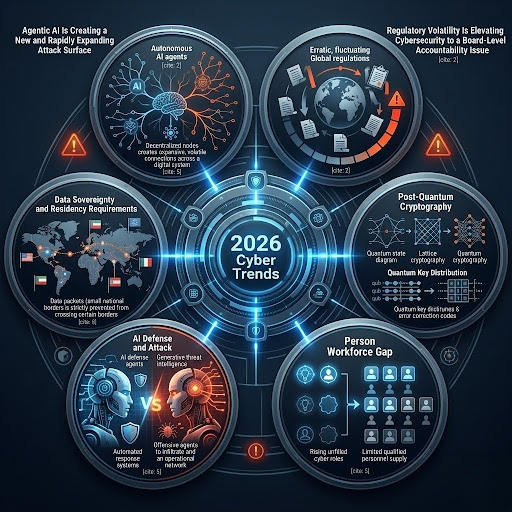
On February 5, 2026, Gartner published its top cybersecurity trends for the year — and the picture it painted is one of profound convergence. Artificial intelligence, regulatory volatility, geopolitical tension, workforce scarcity, and quantum computing are no longer separate forces acting on cybersecurity independently. They are colliding simultaneously, reshaping what it means to lead a secure and resilient organization. For CISOs, CROs, CTOs, and the boards that govern them, 2026 is not a year for incremental adjustment. It is a year for deliberate strategic recalibration.
This article translates the six defining cybersecurity trends of 2026 into the leadership priorities they demand — framed not for technical teams, but for the executives responsible for the decisions that will determine their organization’s resilience and competitive standing in the year ahead.
Six Trends, Six Strategic Imperatives
TREND 01
Agentic AI Is Creating a New and Rapidly Expanding Attack Surface
Agentic AI — AI systems that can autonomously plan, decide, and act — is moving from the lab into the enterprise at a pace that is outrunning governance. Employees are deploying AI agents through no-code and low-code platforms; developers are embedding them into products and pipelines. The result is a proliferating ecosystem of autonomous digital actors operating inside enterprise environments, many of them unsanctioned, unmonitored, and operating with access privileges that have not been formally reviewed or risk-assessed.
This creates a fundamentally new category of attack surface. Agentic systems can be manipulated through adversarial prompt injection, can inadvertently exfiltrate sensitive data, can execute unintended actions, and can introduce regulatory compliance violations — all without any human instruction. The governance gap between how quickly organizations are adopting AI agents and how rigorously they are overseeing them represents one of the most consequential cybersecurity risks of 2026.
LEADERSHIP ACTION POINTS
- Establish a formal AI agent inventory process: every sanctioned AI agent operating in your environment should be catalogued, with defined access permissions, data handling boundaries, and incident response procedures.
- Develop and publish an internal acceptable-use policy for AI agents that covers both employee-deployed tools and developer-embedded systems, with clear accountability lines.
- Integrate AI agent risk assessment into your existing third-party and software supply chain risk management program — AI agents sourced from external vendors carry the same third-party risk profile as any other software dependency.
TREND 02
Regulatory Volatility Is Elevating Cybersecurity to a Board-Level Accountability Issue
The global regulatory environment for cybersecurity has never been more complex or more consequential. In 2026, organizations operating across multiple jurisdictions are navigating a patchwork of overlapping and sometimes conflicting obligations: the EU’s NIS2 Directive and DORA, the SEC’s cyber disclosure rules in the United States, the UK’s evolving post-Brexit cybersecurity framework, and sector-specific mandates across financial services, healthcare, critical infrastructure, and defense. Regulators in multiple jurisdictions are now explicitly holding boards and executives personally liable for cybersecurity failures — not as a theoretical risk, but as an enforced reality.
The strategic implication is direct: cybersecurity is no longer a compliance function that reports upward. It is a governance function that must be embedded at the top of the organization. Boards that lack the capability to interrogate, challenge, and hold accountable their organization’s cybersecurity posture are themselves a regulatory liability.
LEADERSHIP ACTION POINTS
- Map your organization’s full regulatory exposure across every jurisdiction in which you operate, data is stored, or customers are served — and identify where obligations overlap, conflict, or create cumulative accountability risk.
- Ensure your board has at least one director with substantive cybersecurity expertise, or has access to a qualified external cybersecurity advisor whose input is formally incorporated into board-level risk oversight.
- Align your cybersecurity control framework to a recognized international standard — NIST CSF, ISO 27001, or equivalent — and use that alignment as the documented basis for regulatory compliance reporting.
TREND 03
Post-Quantum Cryptography Can No Longer Wait
Gartner’s 2026 forecast contains a warning that deserves to be heard at the highest levels of every organization: advances in quantum computing will render the asymmetric cryptography that currently protects the majority of enterprise data and communications unsafe by 2030. That is four years away. Given the time required to inventory cryptographic assets, migrate systems, update protocols, and validate new controls, organizations that have not yet begun their post-quantum transition are already behind schedule.
The most urgent dimension of this threat is not the arrival of a quantum computer capable of breaking current encryption — it is the “harvest now, decrypt later” attack strategy already being employed by sophisticated state-backed threat actors. Encrypted data intercepted and stored today will be decryptable the moment quantum capability reaches the necessary threshold. Sensitive data with a long shelf life — strategic plans, intellectual property, regulated personal data, classified communications — is already at risk.
LEADERSHIP ACTION POINTS
- Commission a cryptographic asset inventory as an immediate priority: identify every system, protocol, and data store that relies on asymmetric encryption and assess its sensitivity and longevity of protection requirements.
- Engage your technology and security teams to develop a post-quantum migration roadmap, prioritizing the highest-sensitivity, longest-lived data assets first.
- Monitor the National Institute of Standards and Technology (NIST) post-quantum cryptography standards — finalized in 2024 — and begin planning migrations to NIST-approved algorithms, starting with the most critical systems.
TREND 04
A 4.8 Million Person Workforce Gap Is a Strategic Risk, Not an HR Problem
Data confirms that the global cybersecurity workforce deficit has reached 4.8 million professionals in 2026. This is not a new problem, but its strategic dimensions are becoming more acute as the threat landscape grows more sophisticated and the regulatory burden on cybersecurity functions expands. The gap manifests not only in unfilled positions but in skill mismatches — particularly in AI security, cloud security governance, and operational technology (OT) security — that leave organizations exposed in precisely the areas of greatest emerging risk.
For leaders, the workforce gap is a strategic risk management issue, not a talent acquisition problem to be delegated to HR. Organizations that treat it as the latter will continue to compete unsuccessfully for a finite pool of specialists. Those that treat it as the former will invest in alternative models: AI-augmented security operations, managed security service partnerships, reskilling programs, and governance frameworks that reduce the skill burden on human operators.
LEADERSHIP ACTION POINTS
- Conduct a cybersecurity skills gap assessment benchmarked against your current and anticipated threat profile — not just your current team headcount — to identify where automation, augmentation, or partnership can close critical capability gaps.
- Evaluate managed security service provider (MSSP) or security operations center (SOC)-as-a-service models as a structural response to workforce scarcity, particularly for 24/7 threat monitoring and incident response functions.
- Invest in internal reskilling programs targeting the highest-gap areas — AI security governance, cloud security, and OT/ICS security — rather than competing for specialists who are in short supply across the market.
TREND 05
AI Is Both Strengthening Defense and Accelerating Attack — Leaders Must Govern Both Sides
The dual-use nature of AI in cybersecurity is one of the defining strategic tensions of 2026. On the defensive side, AI is enabling faster threat detection, automated incident response, and more sophisticated anomaly identification than human-staffed operations can achieve alone. On the offensive side, threat actors are deploying AI to generate bespoke malware, automate vulnerability scanning, craft highly convincing phishing content at scale, and accelerate the speed and precision of attacks. Both dynamics are intensifying simultaneously.
The strategic error to avoid is treating AI’s defensive potential as a reason to move quickly without governance, or treating its offensive threat as a reason to move cautiously without investment. The organizations best positioned in 2026 will be those that deploy AI-powered security capabilities within rigorous governance frameworks — capturing the speed and scale advantages while maintaining the human oversight that prevents misconfiguration, over-reliance, and adversarial manipulation.
LEADERSHIP ACTION POINTS
- Accelerate investment in AI-powered threat detection and response capabilities — particularly behavioral analytics, automated triage, and AI-assisted incident investigation — but pair every deployment with defined human oversight protocols and performance validation criteria.
- Brief your board on the AI threat landscape as a standing agenda item, not a one-off presentation: AI-generated threats are evolving faster than annual governance cycles can accommodate.
- Evaluate your current security operations against the AI-augmented threat model: are your detection capabilities calibrated for AI-generated malware variants, deepfake social engineering, and automated vulnerability exploitation?
TREND 06
Data Sovereignty and Residency Requirements Are Reshaping Cloud and Infrastructure Strategy
As geopolitical tensions persist and national data protection frameworks proliferate, data sovereignty — where data is stored, processed, and accessible — is becoming a front-line strategic concern for organizations with multinational operations or cross-border data flows. In 2026, data localization requirements are expanding across the EU, Asia-Pacific, the Middle East, and Latin America. Cloud providers are responding with sovereign cloud offerings; regulators are enforcing residency obligations with increasing rigor; and the compliance implications of getting this wrong — including data transfers that violate local law — are severe and in some jurisdictions, criminal.
For technology and risk leaders, data sovereignty is no longer a legal team concern to be addressed reactively. It is a cloud architecture and data governance decision that must be made proactively, with full visibility into where data flows across the enterprise.
LEADERSHIP ACTION POINTS
- Conduct a data sovereignty mapping exercise: for every jurisdiction in which you operate or have customers, identify what data is collected, where it is stored and processed, and whether current infrastructure arrangements comply with applicable residency requirements.
- Engage your cloud infrastructure providers to understand their sovereign cloud and data residency options, and build residency requirements into your cloud procurement and architecture standards.
- Ensure your data governance framework explicitly addresses cross-border data transfer compliance, including standard contractual clauses, adequacy decisions, and any jurisdiction-specific restrictions that apply to your industry.
The Compounding Effect
These six trends do not operate in isolation. Agentic AI expands the attack surface at the same moment that the workforce gap limits the human capacity to monitor it. Regulatory volatility increases accountability at the same moment that post-quantum threats are accumulating in the background. AI-powered attacks are accelerating at the same moment that data sovereignty requirements are fragmenting the infrastructure on which defenses are built.
The compounding effect is a cybersecurity environment in which the pace of change consistently outstrips the pace of governance — unless leaders deliberately close that gap. The organizations that will navigate 2026 most effectively are those whose boards and executive teams have moved cybersecurity from a technical function to a strategic governance priority — resourced, governed, and reported on with the same rigor applied to financial and operational risk.
Gartner’s trends are a starting point. The question is what your organization does with them.
Translate Cybersecurity Trends Into Organizational Action
Karysburg helps boards and executive teams build the governance structures, risk frameworks, and operational capabilities needed to respond to the cybersecurity challenges that define 2026. From AI security governance to regulatory compliance mapping and post-quantum readiness assessments, our advisors work alongside your leadership to turn strategic awareness into operational resilience.
Book a cybersecurity strategy consultation with our team today.