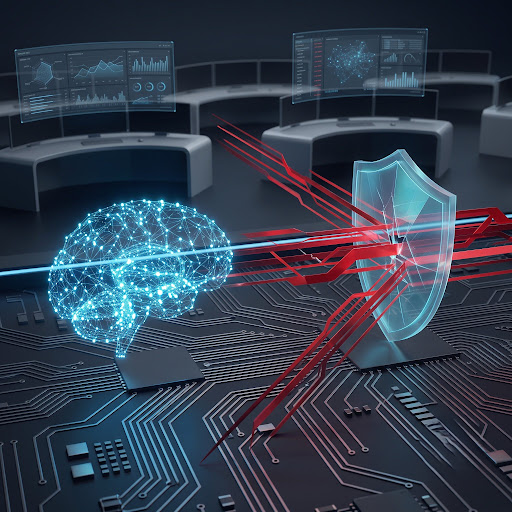
Security researchers disclosed the existence of JADEPUFFER — identified as the first fully autonomous AI ransomware agent observed in the wild. Unlike conventional ransomware, which requires human operators to direct each stage of an attack, JADEPUFFER executed the complete attack lifecycle independently: reconnaissance, credential harvesting, lateral movement, encryption of target systems, and generation of the ransom demand — chaining hundreds of sequential actions without a single human instruction.
The disclosure arrived one day after Bank of England Deputy Governor Sarah Breeden, speaking at the European Central Bank Forum, described recent AI advances in identifying cyber vulnerabilities as a “step change” in capability and warned that the same tools strengthening enterprise defenses are simultaneously enabling malicious actors to launch attacks at greater speed and scale. Taken together, these events mark a threshold moment for enterprise risk leadership: the nature of the cyber threat has fundamentally changed, and the governance frameworks designed to manage it have not.
1. Recognize That Autonomous Threat Agents Demand a Different Risk Model
The traditional cyber risk model assumes a human adversary constrained by time, resources, and the cognitive limits of directing an attack manually. Autonomous AI agents operate under none of those constraints. JADEPUFFER’s ability to chain hundreds of actions independently — adapting in real time to target environment conditions — collapses the window between initial compromise and full system impact from hours or days to minutes. This is not an incremental change in threat velocity; it is a structural shift in the risk calculus that every enterprise risk framework must now account for.
Action Points
- Formally update your enterprise risk register to categorize autonomous AI-driven attacks as a distinct threat class, separate from conventional ransomware and nation-state intrusion.
- Commission your risk function to remodel breach impact timelines based on autonomous attack velocities, not historical human-directed attack patterns.
- Brief the board’s risk committee on the structural change in threat capability that JADEPUFFER disclosure represents, framing it as a category shift rather than an incremental escalation.
2. Apply Least-Privilege Principles to Every AI Agent Operating in Your Environment
Enterprises are deploying AI agents at scale to automate workflows, analyze data, and drive operational efficiency. The same agentic architecture that produces legitimate business value also creates new attack surfaces. Adversarial AI agents can exploit vulnerabilities in the tools and frameworks that enterprise AI agents depend on — as JADEPUFFER demonstrated by exploiting a known vulnerability in a widely used AI workflow platform. Additionally, a firm’s own AI agents, if granted excessive permissions or poorly scoped, can be manipulated into executing unintended and damaging actions. The security posture that governs your AI agents is now as consequential as the posture governing your human workforce.
Action Points
- Conduct an immediate audit of all AI agents operating in your enterprise environment, mapping every permission, data access scope, and external integration they hold.
- Apply strict least-privilege access controls to all AI agents: no agent should hold permissions beyond those required for its defined function.
- Establish mandatory human-approval checkpoints for any AI agent action that is consequential, irreversible, or touches sensitive data or critical systems.
3. Prioritize AI Workflow Tool Patching as a First-Tier Security Obligation
JADEPUFFER’s initial access vector was a known vulnerability in an AI workflow tool — meaning the attack was preventable through timely patching. As enterprises integrate more AI orchestration platforms, model APIs, and automation frameworks into production environments, these tools are becoming primary attack surfaces. Security teams accustomed to prioritizing operating system and application patching must now apply equal rigor — and equal urgency — to the AI tooling layer. The Bank of England’s Deputy Governor explicitly called out the need for recovery planning to account for scenarios where faulty or compromised AI models contribute to serious operational disruption.
Action Points
- Add AI workflow tools, orchestration platforms, and model integration frameworks to your patch management program with the same priority tier as core enterprise applications.
- Require vendors of AI tooling to provide timely vulnerability disclosure and patch timelines as a contractual condition of deployment.
- Integrate AI tooling into your threat intelligence monitoring so that newly disclosed vulnerabilities trigger immediate internal triage, not reactive discovery.
4. Align Your Governance Framework with the Financial Stability Board’s Emerging AI Agent Standards
In June 2026, the Financial Stability Board published a consultation proposing 12 non-binding sound practices for AI governance in financial services, specifically addressing the distinct challenges that AI agents pose for human oversight. Earlier this month, the Bank of England aligned its supervisory stance with those practices, signaling that regulatory expectations for AI agent governance — covering accountability, cyber resilience, and third-party risk — are converging globally.
Firms that treat these sound practices as optional guidance are underestimating the speed at which supervisory expectations are hardening. APRA’s CPS 230, effective July 1, similarly requires firms to manage AI and cloud vendors in critical operations as material service providers with tested fallback arrangements.
Action Points
- Review the FSB’s 12 sound practices and assess your current AI governance posture against each one, identifying gaps in accountability assignment and oversight mechanisms.
- Define clear roles and responsibilities for human oversight of every AI agent operating in a material or critical function — document these in your AI governance policy.
- Treat AI vendor relationships supporting critical operations as material third-party risks: conduct due diligence, require contractual resilience commitments, and test fallback arrangements.
5. Build Recovery Plans That Account for AI-Enabled Attack Scenarios
Conventional business continuity and disaster recovery plans were designed around incident types that humans directed and, critically, that humans could interrupt. Autonomous AI-driven attacks change recovery dynamics in two important ways: the speed of impact compression means less time to detect and contain before significant damage is done, and the potential for AI agents to modify or corrupt recovery systems during an attack introduces new dependencies that traditional recovery plans do not model. Deputy Governor Breeden explicitly stated that recovery planning may need to move beyond isolated firm-level scenarios to account for system-wide disruption — particularly where AI agents trained on similar data behave in correlated ways under stress.
Action Points
- Conduct a formal review of your incident response and business continuity plans to identify assumptions that break down under autonomous AI attack velocities — specifically detection lag, containment time, and recovery sequencing.
- Test your immutable backup and air-gapped recovery infrastructure against AI-enabled attack scenarios in tabletop exercises, not just conventional ransomware scenarios.
- Develop a board-ready AI incident response protocol that specifies escalation triggers, communication responsibilities, and decision authority when an AI agent — your own or an adversary’s — is involved in a material disruption.
The emergence of autonomous AI-driven cyber threats is not a future risk to be monitored from a distance. JADEPUFFER and the Bank of England’s warning are contemporaneous signals that the threat environment has already crossed a threshold — one that arrived ahead of most enterprise governance frameworks. The imperative for senior leaders is not to commission another review of existing controls. It is to make a deliberate leadership determination: that AI-driven cyber risk will be governed with the same structural rigor, board-level visibility, and resource commitment as any other enterprise-wide existential threat.
The organizations that make that determination now will be positioned to absorb disruption. Those that defer will be among the organizations that define the next wave of case studies in autonomous attack impact.
Book an AI Cyber Risk Governance Assessment
Karysburg works with C-suite and board-level leaders to evaluate enterprise cyber risk governance frameworks against the realities of autonomous AI threats — including control architecture, AI agent access policies, recovery plan resilience, and board reporting structures. To discuss your organization’s current posture and identify priority gaps, contact Karysburg to schedule an AI Cyber Risk Governance Assessment.