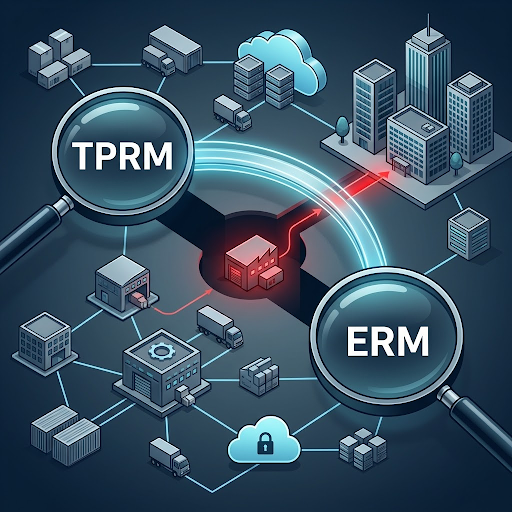
The numbers have stopped being alarming in the way they once were — not because they have improved, but because the industry has normalized them. According to the KPMG 2026 Global Third-Party Risk Management Survey, one third of organizations suffered monetary loss or reputational damage attributable to third-party failures over the past three years, and 28 percent experienced supply chain disruptions with measurable operational impact.
Gartner projects that by 2025, 45 percent of organizations globally will have experienced a software supply chain attack — a figure three times the 2021 baseline, representing one of the steepest acceleration curves in modern enterprise risk history. However, a recent Gartner warning puts it as 80% by 2028. These are not statistics about naïvety. Most organizations are acutely aware that third-party exposure represents one of their most consequential risk domains. The problem is not awareness. The problem is architecture.
What these numbers collectively describe is a structural failure — a persistent, cross-industry inability to govern third-party risk with the same institutional rigor applied to internal risk. Organizations have built TPRM programs, invested in vendor assessment platforms, and populated risk registers with vendor-related findings. And yet, the losses continue because knowledge of third-party risk and integrated governance of third-party risk are not the same thing. The gap between them is not a technology gap, nor a talent gap. It is a governance integration gap — and closing it requires a fundamentally different conversation at the executive and board level than the industry has been willing to have.
The September 2026 risk and governance landscape offers both the urgency and the regulatory scaffolding to demand that conversation now. The question this article addresses is direct: what does genuine TPRM-ERM integration actually require, and what is the cost of continuing to delay it?
The Integration Deficit
The KPMG survey surfaces a finding that deserves considerably more executive attention than it has received: only 18 percent of TPRM programs are fully integrated with enterprise risk management. A further 53 percent describe themselves as “mostly integrated” — a characterization that sounds reassuring until it is stress-tested. Under pressure, mostly integrated systems behave like siloed systems. The taxonomies diverge. The thresholds do not align. The escalation pathways break down precisely when they are needed most. The 53 percent figure does not represent a moderate success; it represents latent structural fragility dressed in the language of progress.
In practice, the integration deficit manifests in ways that are operationally familiar to anyone who has sat at the intersection of TPRM and ERM. Third-party risk programs operate with their own risk terminology, their own severity scales, and their own reporting cadences — often owned by Procurement, Vendor Management, or a dedicated third-party risk function with its own executive sponsor.
Enterprise risk management operates with a separate taxonomy, separate risk appetite thresholds, and a separate reporting line to the Chief Risk Officer and the board. When a TPRM assessment identifies a critical vulnerability in a third-party system that hosts sensitive customer data, that finding must travel through multiple translation layers before it can be evaluated as an enterprise risk. At each layer, severity is re-contextualized, urgency is diluted, and the finding either fails to reach the enterprise risk register at all, or arrives there stripped of the operational specificity that would make it actionable. The signal degrades in transit.
The consequences extend directly into the assurance domain. When TPRM and ERM do not share a common language — a unified risk taxonomy, consistent thresholds, and connected escalation architecture — assurance programs cannot produce a coherent, defensible view of the organization’s third-party risk posture. Internal audit and assurance functions are left to triangulate between two systems that were never designed to speak to each other, generating opinions that are accurate within their respective frames of reference but incoherent when read together. This is not merely an operational inefficiency.
Under the SEC’s cybersecurity disclosure rules, which explicitly require organizations to describe their processes for identifying and managing material risks from cybersecurity threats through third parties, an assurance posture built on structurally disconnected programs creates direct disclosure risk. The representation made to investors and regulators about third-party risk governance may be technically defensible in isolation while being substantively misleading in aggregate.
The Assurance Gap That Regulators Are Watching
Regulatory attention to third-party risk governance has moved well beyond general guidance. The SEC’s 2026 examination priorities explicitly identify vendor oversight and access controls as top-tier cybersecurity governance focuses — a signal that the period of soft expectations around third-party assurance has ended. Regulators are not asking whether organizations have vendor risk programs. They are evaluating whether those programs generate assurance representations that can be substantiated, and whether the processes behind those representations are continuous and integrated enough to credibly reflect the actual risk posture of a dynamic supply chain. The bar has shifted from existence to efficacy.
The assurance methodology question has been addressed in a recent ISACA article. The author argues that the assurance profession has been reluctant to confront institutionally: annual walkthroughs and 25-sample test populations have stopped working mathematically for systems that change continuously. A sample of 25 transactions drawn from a population of millions, evaluated once per year against controls that may have changed dozens of times in the intervening months, cannot produce a statistically credible opinion about control effectiveness.
The confidence interval does not support the conclusion. Another ISACA article extends this argument to the strategic level, framing episodic, calendar-driven assurance as functionally deprecated in the current threat environment. These are not fringe positions. They represent the considered output of the global governance and assurance community’s most authoritative professional body.
The synthesis is clear, and it lands with particular force when applied to third-party assurance. The periodic-snapshot model — annual vendor questionnaires, point-in-time SOC 2 reviews, annual penetration tests, periodic on-site assessments — cannot credibly represent the risk posture of a supply chain that changes in real time. Vendors deploy new code. Configurations drift. Subcontractors are added without notification. Access privileges expand outside contract scope. None of these developments are visible to an assurance function that evaluates the environment once a year. The assurance model must match the risk velocity of the environment it is designed to assess. When it does not, the assurance opinion is not merely incomplete — it is structurally misleading, and regulators are beginning to treat it as such.
From Checklists to Continuous Intelligence
Effective third-party risk management in 2026 is not a questionnaire exercise. It is a continuous intelligence function — one that requires persistent visibility into vendor security posture, contract compliance, financial health, regulatory standing, and operational dependencies across a supply chain that extends, in many organizations, to hundreds or thousands of entities. The KPMG survey documents that more than half of organizations are exploring the use of artificial intelligence for TPRM purposes.
However, only 22 percent report finding AI tools “very effective” in practice — a statistic that reveals less about the limitations of AI and more about the foundational conditions required to deploy it meaningfully. AI tools applied to poor data produce sophisticated-looking noise, not actionable intelligence. The velocity of the output increases; the reliability does not.
The foundational prerequisite for effective AI-enabled TPRM is data quality — and the KPMG survey’s finding that only 15 percent of TPRM leaders express high confidence in the data underpinning their programs is, in this context, an indictment of the entire enterprise. An organization that cannot assert confidence in its third-party risk data is not in a position to derive credible intelligence from that data, regardless of the analytical sophistication applied to it.
Governance investment directed at AI tooling without prior investment in data governance, data validation, and data integration architecture will produce the same result it has produced to date: impressive dashboards that cannot answer the questions boards and regulators are asking. The 78 percent of organizations that do not find AI tools very effective are, in most cases, discovering this lesson at significant cost.
The path forward requires organizations to make a strategic repositioning: third-party risk data must be treated as an enterprise asset, subject to the same governance standards applied to financial data, operational data, and customer data. This means establishing clear data ownership, defined validation protocols, and integration standards that allow third-party risk intelligence to flow into the same reporting infrastructure that serves the board risk committee, the Chief Risk Officer, and the audit committee.
It means building the data architecture before selecting the analytics tools — not the reverse. And it means accepting that continuous intelligence is not achieved through the deployment of a platform. It is achieved through the redesign of the governance processes that produce, validate, and consume risk data on a continuous basis. The technology enables the model; it does not replace it.
What an Integrated TPRM-ERM Model Actually Requires
Genuine integration between TPRM and ERM is not achieved by having both functions report to the same executive. It requires a shared governance architecture with five foundational components that must be deliberately designed, not assumed into existence. The first is a unified risk taxonomy — a common vocabulary of risk categories, severity definitions, and impact thresholds that applies consistently to both internal and third-party risk assessments. Without this, TPRM findings arrive at the enterprise risk register as foreign-language documents that require human translation before they can be evaluated.
Translation introduces delay, introduces interpretation variance, and introduces the real possibility that a critical finding is downgraded not because of a deliberate risk acceptance decision, but because the analyst performing the translation did not have sufficient context to preserve its severity. Taxonomy alignment is not a conceptual exercise; it is a risk management control.
The second requirement is enterprise-level risk appetite applied consistently across internal and third-party contexts. If an organization’s risk appetite statement permits a maximum of five critical infrastructure vulnerabilities in the internal environment before mandatory escalation, that same threshold must govern the evaluation of third-party systems with equivalent access to core infrastructure.
Asymmetric thresholds — tolerating from vendors what would be unacceptable internally — are not a risk strategy; they are a governance arbitrage that attackers and regulators have both learned to exploit. The third requirement is connected escalation pathways that allow third-party risk owners to surface material findings to the CRO and board risk committee without requiring each finding to be re-contextualized at every organizational handoff.
Fourth, continuous monitoring must replace periodic review for high-criticality third parties — particularly those with access to sensitive data, core technology infrastructure, or AI systems with decision-making authority. The KPMG survey’s findings make clear that most organizations have not yet operationalized this standard; the regulatory environment makes equally clear that this gap is no longer acceptable.
The European Union’s Digital Operational Resilience Act provides a useful reference model for what integrated, lifecycle-governed TPRM looks like in regulatory expectation. DORA Chapter V requires financial entities to manage ICT third-party risk across the full contract lifecycle — from pre-contract due diligence through active monitoring to exit and transition planning — and extends this obligation to subcontractor chains, not merely primary vendors. This is not a compliance template to be adopted wholesale across jurisdictions, but it is a governance architecture template that reflects the direction of travel for mature, regulator-grade TPRM globally.
Organizations that have internalized DORA’s logic — continuous, lifecycle-governed, multi-tier third-party risk management — are operating at a level of integration that the KPMG survey identifies as rare. They are also the organizations least likely to be disclosing third-party incidents they did not anticipate. The assurance function must be embedded in this architecture from the outset — generating continuous, auditable evidence of control effectiveness, not periodic opinions whose shelf life expires within months of issuance.
The Strategic Imperative
The organizations that close the TPRM-ERM integration gap in the near term will achieve more than risk reduction. They will be positioned to make credible, defensible representations to regulators, boards, cyber insurers, and counterparties about the integrity of their extended enterprise — representations that are grounded in continuous data, supported by auditable evidence, and aligned with the governance expectations that the SEC, DORA, and the global assurance community are now articulating with increasing precision.
In an environment where third-party incidents are increasingly characterized as governance failures rather than technical surprises, the ability to demonstrate that a material third-party risk was identified, assessed, escalated, and managed through a documented, integrated process is not merely a reputational asset. It is a legal and regulatory defense.
Those that continue to operate TPRM as a compliance function disconnected from enterprise risk strategy will face a predictable sequence of consequences. They will disclose third-party incidents that their governance architecture was never designed to anticipate. They will defend assurance representations they cannot substantiate to the standard that regulators and plaintiffs’ counsel have come to expect.
They will explain to board risk committees why a finding that appeared in an annual vendor questionnaire never reached the enterprise risk register with sufficient severity to trigger a response. And they will do so in an environment in which the regulatory framework — the SEC’s disclosure rules, DORA’s lifecycle requirements, and the emerging global standard for continuous assurance — has removed the ambiguity that once made these explanations plausible. The governance expectations are explicit. The data on third-party losses is unambiguous. The assurance community’s professional consensus is aligned.
The question facing Chief Risk Officers, CISOs, Internal Audit leaders, and the boards they serve is not whether the organization can afford to invest in genuine TPRM-ERM integration. It is whether the organization can afford to continue without it. Every quarter that TPRM and ERM operate as adjacent but unconnected functions is a quarter in which the organization’s extended enterprise is being managed with incomplete intelligence, asserted with unsubstantiated confidence, and exposed to losses that a more integrated governance architecture would have surfaced in time to prevent.
The breach does not care about the organizational chart. The regulator does not accept the silo as a defense. And the board, increasingly, is asking whether the risk program it has been presented with is a true representation of the enterprise’s exposure — or a well-formatted summary of a function that never fully connected to the one next to it
Transform Vendor Data into Enterprise Risk Intelligence
AI-driven TPRM tools are only as effective as the data architectures behind them. Karysburg helps enterprise risk leaders design high-integrity data pipelines, eliminate risk terminology silos, and turn fragmented vendor assessments into real-time, executive-ready risk intelligence.
Request a Data & Analytics Assessment to elevate your third-party data quality and risk intelligence capability.